


David McCormack has a highly unusual success story.
By the nature of how this sort of thing usually goes, as the frontman of a popular Australian rock act in the 90s, he should probably be exclusively remembered these days by elder millennials and Gen Xers who keep listening to the music of their youth on Spotify. But instead, the Dave McCormack of 2026 is still touring his multiple bands, Custard and David McCormack & The Polaroids, and is one of the world’s best-known voices through his work on the global smash hit Bluey.
But Dave has a third secret, highly successful career. He’s not really hiding it. It’s just that no one ever looks at the credits on Australian TV shows.
What most people don’t know about David Liam McCormack is that he is also highly prolific as a composer working in TV. You’ve heard his work on NCIS: Sydney, along with other Aussie shows like Rake, Jack Irish, Five Bedrooms, and the Australian version of The Office.
I wanted to chat with Dave about the way his work in television has intersected with his ongoing work as a musician. And, of course, I had some questions about how all of this has changed with the phenomenon of Bluey, a job he admittedly stumbled into.
No one wants to talk to a composer
Ask Dave at a barbecue what he does for a living and the answer is immediate: composer. “It’s the most neutral,” he says. “It’s a bit of a conversation roadblock. No one wants to talk to a composer.
“Say you’re in a band, or the voice of Bandit, and it becomes a whole new conversation. Say you write music for TV and, more often than not, people either haven’t heard of the show or don’t much like it.”
His way into screen work was less a plan than taking a peek through available open doors. In the 90s, Custard were on a wage, a modest one, though as Dave puts it, “it was great to have a job in rock and roll.”
When he moved from Brisbane to Sydney at the end of the decade, his good friend Andrew Lancaster, who had directed a whole bunch of Custard videos, was running a company called Supersonic that made music for commercials. A client wanted a jingle that sounded, in the parlance of the time, “a bit Custard-y.” Dave knocked out a riff on a basic home setup, Andrew produced it up, and the client loved it.
From there the career evolved: an early-2000s animated series called Deadly, then Garage Days, Alex Proyas’s feature film about a Sydney band, for which Dave wrote songs and score alongside Lancaster and Anthony Partos, who “opened the door and let me in.”
Working in a band, but for television
That collaborative experience eventually became a career. In 2010, Dave and a half-dozen others, mostly film composers, started Sonar Music. He describes it less as a company and more a share house of ideas. “It’s very easy composing music to get insular, just looking at the grid and the tempos on the screen,” he says. Sonar means there is always someone to ask whether a cue should be fast or slow, or whether he has completely missed the mark. He likens it, only half-joking, to art college for the Beatles and the Stones: “it is just a melting pot of ideas and creativity.”
You’ve likely heard his music as a composer on theme songs and/or the scores for TV shows including The Office (Australia), NCIS: Sydney, Five Bedrooms, Doctor Doctor, Top End Wedding, Jack Irish, Black Comedy, Bump, House Husbands, Redfern Now, and SeaChange (2019).
He also worked on the underrated ABC mini-series Friday on My Mind, a great little two-parter about the similarly underrated Australian band The Easybeats.
The irony of this is that while Dave will be remembered for his work as the frontman for bands like Custard, The Titanics, and David McCormack & The Polaroids, it’s this TV work that will have longevity with repeats of shows like NCIS Sydney played on TV for decades to come.
“It's funny… I see it all through the same lens. I put all my focus on whatever it is at the time, not thinking about, longevity or whatever. The stuff for pictures, like TV stuff, I think that's has more longevity than the music.
“Like The Polaroids stuff, we'll do a gig every now and again, and you know, seven people might buy a record and then 12 people might have streamed it. And then it's sort of gone. Whereas these other things get repeated over and over again to more people. But when I'm doing it, I just get really in the zone as much as I can.
“I’ve been writing pretty much the same songs for 40 years,” he says, “just playing them with different people.” He doesn’t sort them into Custard songs and Polaroids songs so much as vibe with whoever is playing with him in the room.
Right place, right decade
For a certain kind of Australian kid in the 90s, Custard arrived at the same moment as Recovery, a sprawling three-hour Saturday morning show that handed the ABC over to the nation’s teenagers. It was that generation’s Countdown.
This year marks the thirty year anniversary of the show and, looking back, it is hard to overstate the energy around local bands then and how much their success can be attributed to the youth show.
Dave is generous about how much came down to timing. Custard formed in Brisbane just as Triple J went national and, crucially, began broadcasting out of Brisbane. “We were very lucky to be one of the few bands in Brisbane that happened to have a release about the same time,” he says.
“Talk about being in the right place, the right decade at the right time. We were there.” A live spot beamed into lounge rooms in Perth meant you could suddenly play a gig in Perth. “We’d play Brisbane gigs and then suddenly, wow, we can go to Sydney and do a gig. People might know one of our songs? That’s insane.”
He even hosted an episode, which he recalls with something close to trauma. “It was hell,” he says, cheerfully. “Three hours live every Saturday morning. I fumbled my way through it, and they had such great people helping out, but I was completely exhausted. You’ve gotta interview people about some crap book they’ve done.”
Did it shift his profile? In a pre-social-media world, McCormack says he genuinely couldn’t tell. “Profile was so hard to judge back then, because there were no clicks or likes or friend requests,” he says. “It couldn’t have hurt, I guess.” Mostly, though, he was just living in a suburb of Brisbane, insulated from any sense of it. “There was no change.”
It is a very Brisbane way to view your own fame.
I’d argue that Recovery not only broke bands, but it also created a public persona for several musicians at the time, with McCormack and his wry comedic sensibility more resonant than most.
Without Recovery we might still have had the same bands defining that period of Australian music, but without Recovery would we have “Dave McCormack?”
Bandit enters the room
And then there is Bluey, which Dave stumbled into. As he tells it, Sonar sits next to a post-production house called Unison Sound, and Dave got chatting to some fellow Brisbane expats in the hallway. Someone mentioned they needed a voice for the dad in some show. Dave said initially that he couldn’t do it, but they insisted he gives it a go.
He recorded that first episode, “The Weekend,” down a Skype line, playing a dad on the couch trying to watch the cricket and air-drumming at the kitchen table. He found it instantly relatable, assumed it was a one-off, “like a Tropfest film,” and moved on. Then they sent him the finished thing, it was wonderful, and that, he figured, was that.
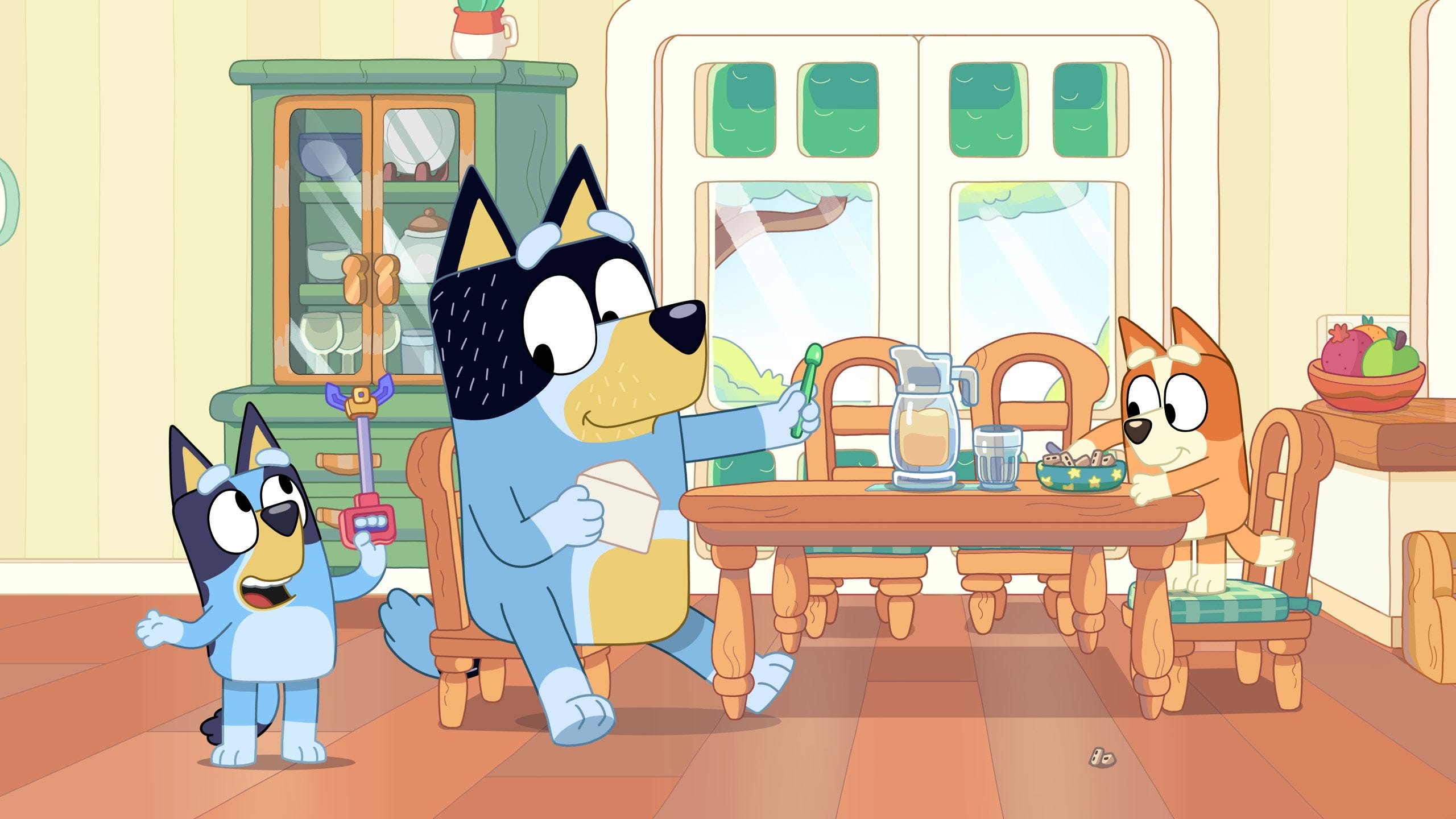
Roughly 150 episodes later, he says it has never once felt like work. A lot of that is owed to the show’s creator, Joe Brumm, who has daughters around the age of Dave’s own.
Much of Bandit’s most quotable material, the “biscuits,” the “salad dodgers,” the “what up, party people,” was Brumm’s, right there on the page.
I’m the father of an almost five year-old, so have had Bluey as a constant in my life for a number of years now. Dave’s voice is regularly a presence in my home for reasons other than me refusing to sunset the songs of my youth. Knowing Dave’s on-stage banter voice, there’s a line that Bandit delivers in an episode that I was certain didn’t begin life in the show’s script.
“Dad enters the room” is Dave reading a stage direction aloud by mistake. The team liked it enough to lean into the joke.
That Bluey movie…
Set for release in August 2027 is the highly anticipated feature film that will take Bluey and the Heeler family to the big screen. Dave confirms that he has finished recording for the movie and that the experience was just as chill as it was to record lines for the TV show.
It’s surprising to hear this, with the film produced as such a bigger scale with Disney now involved in the production.
Dave went into this expecting bigger stakes and a more traditional Hollywood experience.
It was nothing of the sort. “It was still really grungy and lo-fi. We did it in the same studio booth that I did the very first thing for the pilot,” he says. “It was just me in the booth with Joe, and it was absolutely no different. I was preparing for a real different experience, but it was exactly the same, which was great.” The result, he reckons, barely registers as a movie at all. “It doesn’t feel like a big, ‘Oh my God, it’s a movie.’ It just feels like a really, really long episode.”
“I always have in my mind, like you see in those Hollywood films, they’re all reading scripts of all different coloured pages around a big table, and they’re in activewear and they’re drinking weird juices,” he says.
While the voice work is done, he is set for a few weeks of promoting the film. There is no itinerary yet. “There’s a period of time where I’ll have to talk about it for a couple of weeks,” he says.
“I’m prepared for it.” The tricky part of the press tour, he says, is that audiences credit him and Melanie Zanetti, the voice of Mum, with a wisdom neither of them claims. “They think that we have all the answers for the show,” he says. “They’re like, ‘What are your top ten tips for parenting?’ It’s like, huh? I don’t know.”
Maybe it is this song / that I’ve been looking for
Bluey has made Dave a recognisable Australian voice, which has opened another door to work he never knew existed: Event Cinemas promos, audiobooks about a pangolin named Penny, and Telstra ads with a very catchy musical melody.
Dave never changes his voice; he just talks, and clients are sold. At comic-cons, career voice artists ask, with a mix of bewilderment and mild annoyance, how on earth he landed the gig. The honest answer: he didn’t even have an agent.
He is, in expected Dave McCormack fashion, unbothered by all of it. There is a fresh batch of six songs recorded in Brisbane in January with friends Adele Pickvance (formerly of The Go-Betweens) and Nick Naughton (formerly of Gentle Ben & His Sensitive Side), Custard shows booked for July and October, and the small matter of that movie. When I note that Bluey is somehow still the biggest thing going, Dave seizes on the word. “Still,” he repeats. For the first couple of years it was “Bluey’s so popular.” Now it is “Bluey’s so popular, still.”
If he is right that the peak is yet to come, the composer at the barbecue may need a better roadblock.
That’s the newsletter for the today.
Consider becoming a paid supporter of Always Be Watching.
Connect with Dan on Bluesky. Connect with Dan on Letterboxd. Connect with Dan on Linkedin. Challenge him on the NYT word game Crossplay. Email Dan @ alwaysbewatching.com or just reply to this email.
If you've never experienced the joy of being at a Custard gig, here's a bootleg I made in 2011.
https://www.youtube.com/watch?v=S5CMuLHEUo4