

Maybe it is time to kill SBS...
This week's newsletter starts with a murder. Just like every drama series on SBS.

I love television. One of the reasons I fell in love with television is the Australian TV channel SBS. And thus, I love SBS.
It is one of two public broadcasters in Australia and as much as I adore SBS and support its mission statement, increasingly I feel like digital disruption has disrupted SBS right out of the value it once brought Australia.
We need to kill SBS in order to strengthen its intent..
But first, I want to explain to Always Be Watching readers outside of Australia what SBS is, as it is really unique.
SBS launched in 1975 to deliver foreign language radio services to multicultural Australia and in 1980 expanded its remit include a broadcast TV channel. Its stated purpose is "to provide multilingual and multicultural radio and television services that inform, educate, and entertain all Australians and, in doing so, reflect Australia's multicultural society."
The TV component of it these days includes a main broadcast TV channel, a youth skewing SBS VICELAND channel (is it the last remaining VICELAND channel in the world? I’m not sure why SBS hasn’t rebranded it… the volume of VICE content on there has been pretty limited for years), SBS Food, NITV (focused on content reflecting First Peoples from Australia and abroad), World Movies, and a WorldWatch news channel playing bulletins from around the world. It also operates the very good SBS On Demand free, ad-supported streaming service that carries a deep library of international TV shows and movies alongside catch-up SBS programming – it is Australia’s best streaming TV service.
SBS is smart and entertaining public television.
Last week there was a very interesting interview recorded with ABC Managing Director Hugh Marks. The ABC being Australia’s other public broadcaster. It is more directly funded by the Australian tax-payer, with the smaller-footprinted SBS propped up by funding through advertising and other commercial partnerships.
ABC business analyst Alan Kohler delivered softball questions to his boss for around 40 minutes, but the answers were fairly revelatory. Marks, who took on the MD role just over a year ago after a lengthy and successful career in commercial media, talked about the need to rethink where value was found in ABC programming and its need to break away from programming that has successfully filled a linear schedule and instead produce programming that connects more directly with audiences.
For most of the 40 minutes there was a chance that my head was about to fall off because I was nodding so hard. From a very broad perspective, Marks was saying the right things.
“I’ll give you an example: a legacy television show that has been around for 40 years,” he told the podcast.
“There’s still a lot of work that goes into it. All that work is valid and there’s a lot of people working hard to do it, but that particular show may not be the sort of content that we want for the future.
“I won’t give specific examples because then there’ll be teams that go, ‘What does that mean for me?’ But I think I’ve spoken about this challenge a lot and everybody agrees with me.”
He’s talking about Compass, isn’t he?
Of course, just because Marks was broadly saying the right things about what needs to be addressed at the ABC doesn’t mean he was communicating anything in the interview in the way of vision of what he would bring to the ABC.
Half marks for Hugh on that.
What resonated most with me was his comment that:
“I think the biggest challenge is the ABC has trouble stopping things,” he said.
“Why? Because generally when we stop things, there are some people still rusted on to that particular program or format.
Which brings me back to SBS.
Last week also saw Australia’s far right lurching political party One Nation issue statements about its desire to strip back ABC funding and to eliminate SBS altogether. In a statement sent directly to Mumbrella:
“Broadly, we don’t support ongoing taxpayer funding for the SBS. It was created to provide content from overseas in pre-internet days; there’s no longer any need for taxpayers to fund that.”
On the face of it, One Nation is correct. The mandate that made SBS necessary in the past isn’t anywhere near as strong in the current moment. A lot of the value SBS delivers is replicated by commercial broadcasters like Netflix and Prime Video.
But where One Nation is speaking out of its arse is that its barely-there media policy is built on ill-considered culture war nonsense. Mostly, One Nation doesn’t want to support a multicultural Australia built on progressive immigration.
But, the question should be asked about what value SBS provides as a public broadcaster in the current media era. This is a question that should be asked of all public broadcasters regularly.
Is it necessary? Or is it just a nice to have? After all, public money should also be spent on things like hospitals and schools and roads and lots of other really vital expenditure.
Is it time to kill SBS? I opened this newsletter saying that yes, we should.
And I believe we should… to a point.
Yes, there are elements of SBS that are being replicated by commercial entities. There’s no shortage of high quality foreign-made movies and TV shows on rival streaming services. But it is probably also important to consider the cultural value that free-to-access video and audio streaming & broadcasting delivers to the enrichment of the community.
The local council offers the community a library, despite there being retail bookstores on the same city block. And we don’t just want there to be libraries. We want them to be good libraries.
But the question I keep coming back to is: Why do we need two public broadcasters? You don’t find two local libraries standing side by side.
Hugh Mark’s is right that we need to step back and consider what SBS and the ABC are doing well and where operations could be combined.
I’m not here to do a full analysis of this, but some thoughts off the top of my head:
There’s obvious back room savings that can be found merging the obvious. Accounting, marketing, HR (I understand there’s some improvements the ABC might need to make in this team these days…), etc
News content aside, the general entertainment offer from SBS with its movies, TV show and documentary acquisitions, etc often has SBS doing a better job of being the ABC than the ABC is.
ABC Kids is incredible. World Movies is also a great value add.
SBS Food on the other hand has always felt like disposable filler.
Most of the SBS VICELAND service is also filler that could very easily be combined with ABC Entertains without missing a beat. Relevant first-run content barely exists on either in prime time hours.
I’d also challenge the idea that Australia is well-served by having linear general-entertainment channels at all. Get rid entirely of ABC Entertains and SBS VICELAND – acquire that youth-focused content, but save some on transmission costs and keep the shows for on demand audiences
Is Australia well-served by having both the SBS World News and ABC’s The World? Obviously not. More world news across the ABC News channel in general would probably be a plus.
Consumer behaviours are shifting. Audience needs have shifted even more dramatically. A combined ABC/SBS is a considerably stronger ABC/SBS.
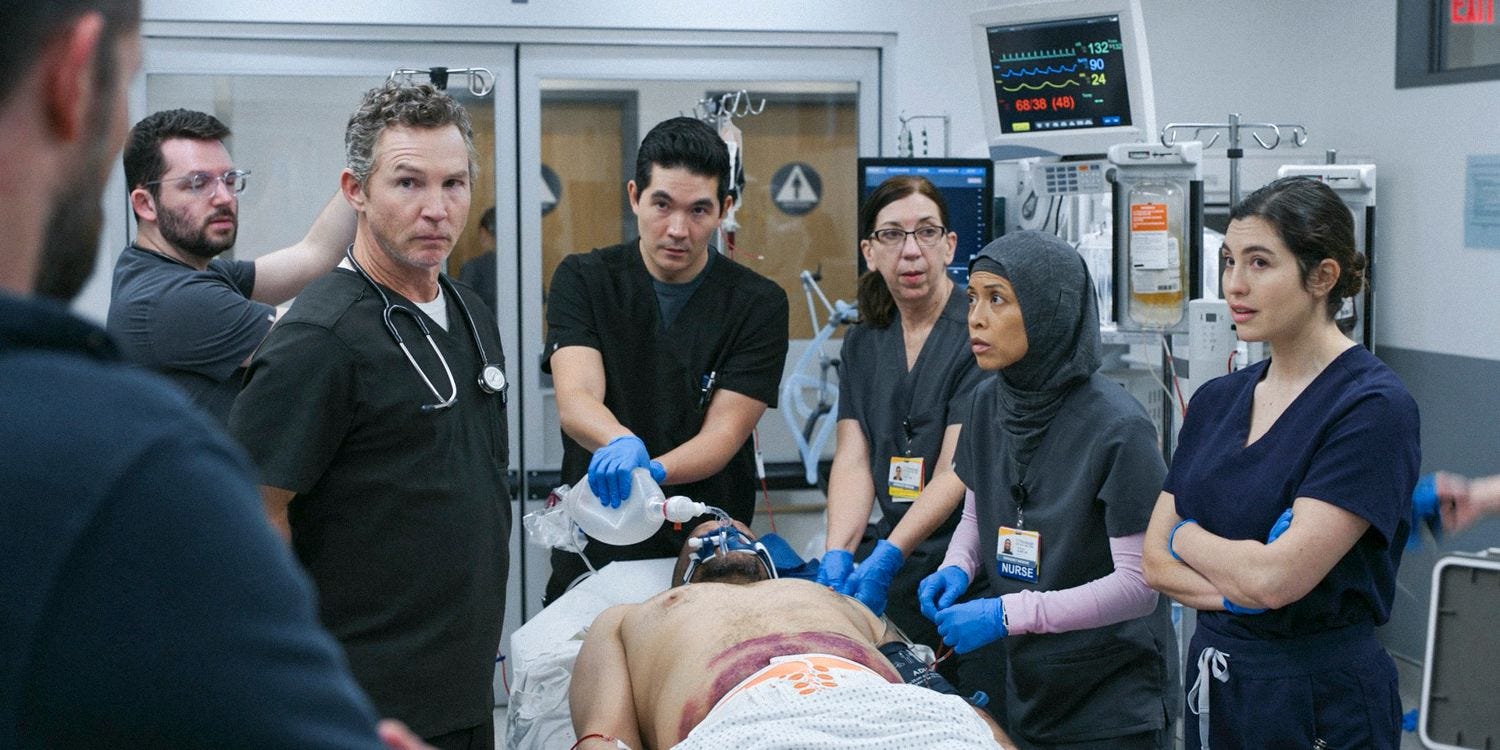
Don’t expect a night shift The Pitt spin-off
The Pitt star and co-creator Noah Wyle has been getting a lot of blowback for comments he made on a podcast recently where he said that viewers are getting enough of the night shift on the show.
From The Wrap:
Wyle shared that he was blasted as “patronizing and pretentious” for this answer, but still doubled down on his stance, noting, “I still don’t think you need more night shift. Those are great characters. It’s a wonderful energy.”
“You know who works mostly night shift? Mothers,” he went on. “Because they like to be free for their kids [and] to be home during the day. So, it’s a lot less wild and woolly, and a lot more boring and sedate than you would think.”
“I’ll say personally, I feel like when you have something that’s a really good thing and it’s working for you, you don’t want to dissipate it too quickly,” he said. “You don’t want to bleed it off into other narratives and franchise it out, because I think you kind of dilute the potency a little bit and you get everybody overfamiliar with the arena to where it loses a little bit of its specialness.”
He’s probably right about a night shift show being too much of a good thing… even if I’d like to see The Pitt take an opportunity one season to invert the format and give us a handful of episodes of the day shift before doing the rest of the season at night.
What I reckon he’s 100% on the money about though is just how sedate night shifts in emergency rooms can be. From the times I’ve found myself in emergency rooms, it starts to get awfully quiet after dinner time…
News Desk
Among the final run of guests in this final week of The Late Show with Stephen Colbert: Jon Stewart, Steven Spielberg, and Bruce Springsteen. Read Late Nighter
The season finale of SNL UK, with host Ncuti Gatwa, was its lowest-rated with just 86,420 viewers. That’s down 28% from its previous low. The show was up against the Eurovision Song Contest, which accounts for the hammering. Read: Deadline
The Hôtel Martinez will be the main hotel location for season four of The White Lotus. Read: THR
The publicity for HBO’s new Lanterns show, based on the Green Lantern comics, is ramping up. Ahead of the new trailer released by this time tomorrow, showrunner Chris Mundy has given an interview with EW to create a fan-friendly framework for the series, revealing that the show will take place across two different timelines. Read: EW
RIP Joe Sedelmaier. The award-winning TV commercial director was 92. He is best remembered for his iconic Wendy’s commercial “Where’s the Beef?” Read: NYT
Blumhouse Productions/Atomic Monster is in development on a live action series based on the nifty comic book series Chew – it’s about an FDA agent who gets visions of crimes from whatever he consumes as food. It can get pretty gross. Read: Facebook
French-Canadian series Le Clan is in development as a modern Western at Peacock. Read: THR
The Greatest American Hero star William Katt is launching a Kickstarter for a comic based on the show. I’m still very keen to see the pilot for the recent effort to revive the show with Hannah Simone from New Girl starring. Read: Bleeding Cool
Trailer Park
The Walking Dead: Dead City is back for season 3 on AMC July 26.
That’s the newsletter for the today.
Consider becoming a paid supporter of Always Be Watching.
Connect with Dan on Bluesky. Connect with Dan on Letterboxd. Connect with Dan on Linkedin. Challenge him on the NYT word game Crossplay. Email Dan @ alwaysbewatching.com or just reply to this email.
Missing from your analysis of SBS is the online offering: the SBS News website was the 10th most visited news website during the recent Federal election and provides analysis and information for multicultural audiences that they simply can't get reliably from overseas sources.
The ABC has been overstepping it's remit by heading into SBS territory for a few years now: China Tonight being an obvious example. Modern technology has enabled parallel/siloed societies to exist comfortably within Australia for about a decade now but that means a strong and well funded SBS that provides specific and targeted programming to defined migrant communities to assist them in understanding, and subsequently integrating into, Australian society and culture is more essential than ever.
Dan, not sure the ABC MD was talking about "Compass" in his musings about what programs that seem to be rusted on to the schedule. A low-cost, often very innovative slot, Compass is one of the very few areas of the ABC open to films that are created outside the the ABC group-think bubble, and also one of the few entry points left for new and emerging filmmakers to get an airing on the network. Might be more likely Hugh Marks was referring to Australian Story which has become very tired, doesn't gather much YouTube traction and rarely if ever deviates from its formulaic approach for fear of offending its aging audience. Compass does a much better job of surprising and challenging viewers. Last year Compass cleaned up virtually every award at the Australian International Doc Conference - while Oz Story hasn't broken new ground in years