

Rethinking Aussie TV as soft power as US TV declines

I love American TV. Or, as I call it: TV. Since the early days of television, the US has been a global leader in terms of the volume of TV produced at a pretty high quality level.
It’s quite easy to detach yourself as a viewer from the idea that the TV shows are coming from a specific country with specific ideologies when there is so much artifice involved in any form of screen storytelling. What we are watching isn’t a true reflection of the country of origin. So, when watching shows or movies from the US, so rarely do I think of the experience as watching a US show or movie - instead, I’m just watching my stories.
But, the real world has intruded on that disassociation in a pretty major way.
While, yes, there has been a temporary rollback of tariffs announced today, it comes after a week where the US President, taking a break from playing in golf tournaments and planning a military parade to celebrate his birthday, made some boneheaded decisions about international trade. The consequence was that he upset the world order, f**ked up global economies, severely dented everyday people’s superannuation/401ks, and lit the fuse on inevitable price hikes which will soon see everything becoming more expensive.
The only reason the US has any goodwill left from a global perspective is 100-ish years of soft power enforced through its screen production. We love America because of I Love Lucy, The Jetsons, The Golden Girls, Charlie’s Angels, The Sopranos, Sex & The City, Friends, Baywatch, The Simpsons, Seinfeld, Frasier, Cheers, and The Big Bang Theory.
If Trump in the last week has radically shifted the world order, outside of the US we need to consider that we are likely about to see a cultural vacuum too.
It’s time for Australia to stop thinking about Australian TV as just telling our stories for local audiences or as engines for the local screen industry and instead think about how Australian TV can play a role in whatever role the country wants to start playing on the global stage politically.
Two weeks ago the new Canadian Prime Minister Mark Carney delivered a hell of a speech where he announced that the relationship Canada once shared with the US, its closest neighbour, is over.
“The old relationship we had with the United States based on deepening integration of our economies and tight security and military cooperation is over,” he said.
“It’s clear the US is no longer a reliable partner. It is possible that with comprehensive negotiations, we could reestablish an element of confidence but there will be no going backwards,” the Canadian leader said, adding that future governments would have to grapple with the same changed dynamic.
“There’s even more to do, and that’s why I chose to go to France and the United Kingdom, two long-standing and reliable partners, friends and allies of Canada,” Carney said, referring to his first international trip as prime minister.
In the coming months, stronger ties will be forged globally by countries seeking alliances to plug that hole the US is forming. This will be for economic and military reasons. But culture should play a role in it.
Over the last few years there has been a discussion in Australia about forcing local content quotas onto international streaming services. I’ve long argued that we actually really don’t want international companies telling our stories. They’re never really authentically Australian and often will have US actors either playing Australians or will rely on that tired idea of “American gets mixed up in unexpected Australian stuff (usually crime or strange culture in a small town)”.
Now, more than ever, local content quotas aren’t in our best interests.
If we are now thinking about how we need to re-establish our presence globally and forge stronger relationships with international allies, the soft power capabilities of our television (and the shows we export) should be a key consideration.
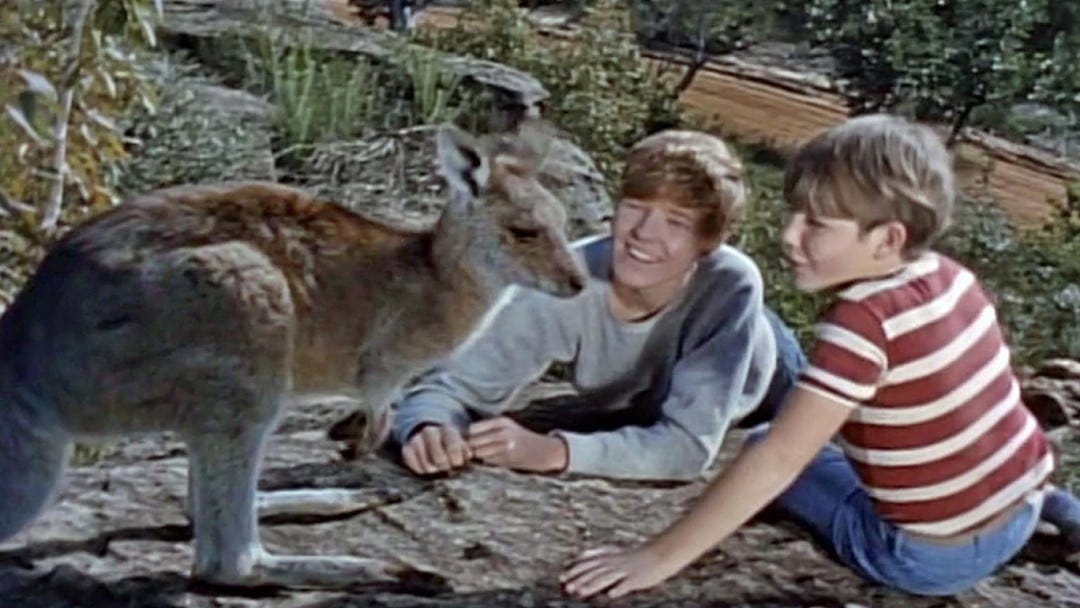
We need to be ramping up investment in local productions that are telling our stories in an authentic way (with Australian creatives leading it in front of and behind the camera). But it goes beyond just making the shows. We need to think of our TV as a handshake with countries we do want to forge stronger ties with.
We also need to ramp up more co-productions and improve distribution of content. For example, the Government should be opening a pathway for Australian pubcaster ABC to strike content output deals with Canada’s pubcaster CBC and cross-share local programming at subsidised rates.
Already we engage in TV as soft power activity with international TV service ABC Australia, which broadcasts TV services throughout Asia. It is funded by our Department of Foreign Affairs and Trade and delivers scripted, news, sports, education, and lifestyle programming. But we need to think more globally than just Asia and certainly more strategically.
I’m still going to be watching my US shows. My relationship with US TV is 40+ years strong now and I don’t expect it will change drastically anytime soon. But, we are likely about to see a major shift in how much television globally is weighted towards the US.
TV is already more global thanks to the international programming served by streamers like Netflix and Prime Video. My suspicion is that we are going to see that shift accelerated.
Australia needs to seriously reconsider the value of our local television and that it can be weaponised to give Australia a stronger voice in a new world order.
Related:
The UK Culture, Media & Sport Committee (CMSC) has officially recommended a 5% levy be placed on streamers with the money paid into a cultural fund administered by the BFI to support domestic HETV production. Read: Deadline
Meanwhile Netflix has said that if such a levy is introduced, it will raise subscription fees and pass the cost onto consumers. Read: Deadline
The big tariff winner? US cable finance stations CNBC and Fox News Business, which have both seen ratings spikes. Read: NYT
News Desk
In the march towards Emmy nominations, here’s a really good feature article on Noah Wyle and The Pitt in Variety.
Ahead of the season 2 launch of The Last of Us, HBO has renewed it for a third season. Read: Indiewire
Was there a Walton Goggins / Aimee Lou Wood feud? NYPost explores this essential story.
Alana Thompson will narrate Lifetime’s upcoming biopic about her childhood, I Was Honey Boo Boo. On one hand, I can’t believe anyone would watch this. On the other… I think I would watch this. Read: People
In THR’s obviously silly list of the 20 sexiest (US) TV shows there are some surprising deep dive titles in there. Read: THR
Talks have begun for season 2 of Adolescence. Read: The Guardian
Japan’s Sony has already factored in tariff pricing into US prices for its 2025 TV’s. Read: The Verge
Trailer Park
Nonnas debuts on Netflix May 9.
After the loss of his mother, Joe Scaravella (played by Vince Vaughn) risks everything to honor her by opening an Italian restaurant with a group of local grandmothers as the chefs.
Murderbot debuts on Apple TV+ May 16.
Based on Martha Wells' bestselling Hugo and Nebula Award-winning book series "The Murderbot Diaries," "Murderbot" is a sci-fi thriller/comedy about a self-hacking security construct who is horrified by human emotion yet drawn to its vulnerable clients. Played by Skarsgård, Murderbot must hide its free will and complete a dangerous assignment when all it really wants is to be left alone to watch futuristic soap operas and figure out its place in the universe.
Last Bullet debuts on Netflix May 7.
Car genius Lino returns to conclude his vendetta against Areski and the corrupt commander who ruined their lives in this turbo-charged trilogy finale.
The Devil’s Plan: Death Room debuts on Netflix May 6.
Culpa Nuestra debuts on Prime Video in October.
Jenna and Lion's wedding leads to the long-awaited reunion between Noah and Nick years after their breakup.
Long Way Home debuts May 9 on Apple TV+.
Brett Goldstein: The Second Best Night of Your Life debuts on HBO / Max on April 26.
That’s the newsletter for today.
Consider becoming a paid supporter of Always Be Watching.
Connect with Dan on Bluesky. Connect with Dan on Letterboxd. Connect with Dan on Linkedin. Email Dan @ alwaysbewatching.com or just reply to this email.
Great read today Dan and whole heartedly agree. We don't seem to capitalise on our TV industry as a legitimate export. We tell some really great stories which is generally only viewed locally.
Good idea, as long as it is not just ‘high art’. Australia has, through its soap operas, Neighbours and Home and Away, projected soft power across the world, especially Britain. We might have success through our a grade movies, like the original Mad Max, and not just our high art movies. On another note, I really hope Murderbot lives up to the novellas and novels written in the sequence of stories.